
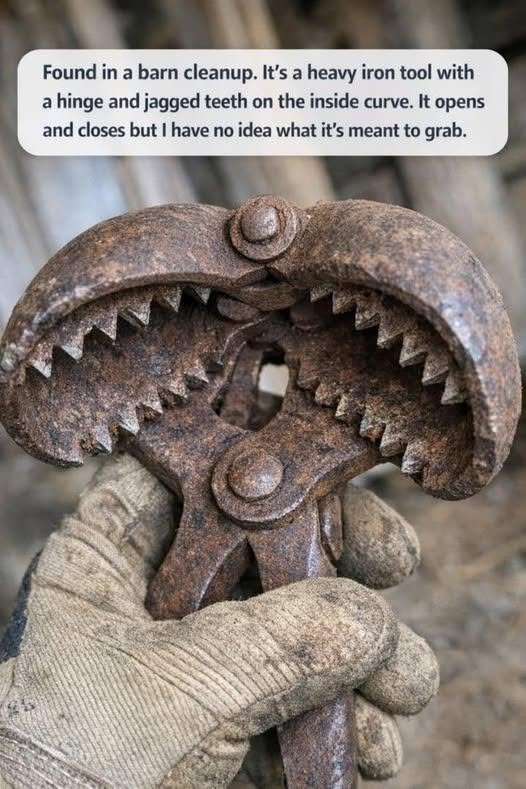
Secret Unveiled: The Antique Handheld Corn Sheller Discovered in Barn Cleanups
In the quiet corners of old rural barns, forgotten treasures often lie hidden under decades of dust and rust. These relics hold the untold stories of 19th- and early 20th-century homesteaders who relied on heavy, purely mechanical tools for their daily survival.
One common mystery find during modern barn restorations is a heavy, hinged iron tool featuring curved inner jaws lined with quarter-inch jagged teeth. While it resembles a cross between blacksmith pliers and an exotic mechanical clamp, this implement is an essential piece of vintage agricultural equipment: an antique handheld corn sheller.
Anatomy of the Tool
-
Material & Weight: Cast entirely from solid iron, weighing roughly 3 pounds. Its heavy construction was built to withstand thousands of high-pressure uses without bending or snapping.
-
Central Hinge: Located at the midpoint, acting as a fulcrum to multiply hand squeezing force.
-
Jagged Inner Teeth: The curved inner jaw features offset sharp iron teeth (~¼ inch long) specifically angled to grip round objects without crushing the center core.
How It Works
Before automated processing mills or box-style hand-crank shellers became affordable, farmers hand-shelled dried corn to feed livestock or grind into meal. Doing this purely by hand was agonizingly slow and left workers with severe blisters.
Place a dried ear of corn directly into the curved, toothy jaws of the iron sheller.
Squeeze the handles together so the inner jagged teeth bite into the base of the dried kernels surrounding the cob.
Twist the tool around the cob while pushing downward in a single fluid motion. The angled teeth wedge under the kernels, stripping them off the hard central cob cleanly and efficiently into a bucket below.
For Complete Cooking STEPS Please Head On Over To Next Page Or Open button (>)

Crunchy Chicken Taco Salad

This Clever License Plate Has Everyone Talking — Can You Spot Why

The 7 kilo baby who amazed the world in 1983: this is how it looks today, at the age of 40

I Thought the White String in My Egg Was Something Dangerous—The Truth Completely Surprised Me

Did you know that when a SLUG visits your house it means that you
